 Add to Chrome
 Add to Firefox
 Add to Edge
A strongly annotated passive acoustic dataset for tropical bird monitoring
May 21, 2026
Passive acoustic monitoring enables continuous, non-invasive biodiversity assessment across diverse ecosystems. The scale of these datasets has driven the adoption of machine learning, with supervised approaches showing strong performance. However, supervised methods require time-resolved annotated datasets, which remain scarce, especially in complex tropical soundscapes. We present PteroSet, a curated dataset of strongly annotated Neotropical bird vocalizations recorded in Puerto Asis (Putumayo) and Pivijay (Magdalena), Colombia, between 2023 and 2025. The dataset comprises 563 recordings (73.62 h) and 15,372 time-frequency annotations, including 6,702 events identified to the species level across 168 species. We release the annotations in a COCO-inspired JSON schema that unifies audio files, taxonomic categories, and labels for machine learning workflows. Beyond providing annotated data, PteroSet serves as a realistic benchmark that highlights key characteristics of tropical soundscapes, including acoustic co-occurrence and domain shift across recording sites. We provide a deep learning baseline for binary bird detection, demonstrating PteroSet's usability and the challenges it presents.

From Pixels to Patches: Pooling Strategies for Earth Embeddings
Mar 02, 2026As geospatial foundation models shift from patch-level to pixel-level embeddings, practitioners must aggregate thousands of pixel vectors into patch representations that preserve class-discriminative signal while matching downstream label resolution. The default choice, mean pooling, discards within-patch variability and can drop accuracy by more than 10% under spatial shift. To evaluate this effect, we introduce EuroSAT-Embed: 81,000 embedding GeoTIFFs derived from three foundation models: AlphaEarth, OlmoEarth, and Tessera. We benchmark 11 training-free and 2 parametric pooling methods under both random and geographically disjoint test splits. Our results show that richer pooling schemes reduce the geographic generalization gap by up to 40% relative to mean pooling and increases accuracy by up to 5% on spatial splits. We recommend Generalized Mean Pooling (GeM) as a drop-in replacement for mean pooling: it improves accuracy without increasing embedding dimensionality. For maximum accuracy, Stats pooling (concatenation of min/max/mean/std pooling) performs best at 4x the embedding size. We further find that pooling effectiveness varies across embedding sources and that higher-dimensional embeddings benefit most from distributional statistics.
TEMPO: Global Temporal Building Density and Height Estimation from Satellite Imagery
Nov 15, 2025We present TEMPO, a global, temporally resolved dataset of building density and height derived from high-resolution satellite imagery using deep learning models. We pair building footprint and height data from existing datasets with quarterly PlanetScope basemap satellite images to train a multi-task deep learning model that predicts building density and building height at a 37.6-meter per pixel resolution. We apply this model to global PlanetScope basemaps from Q1 2018 through Q2 2025 to create global, temporal maps of building density and height. We validate these maps by comparing against existing building footprint datasets. Our estimates achieve an F1 score between 85% and 88% on different hand-labeled subsets, and are temporally stable, with a 0.96 five-year trend-consistency score. TEMPO captures quarterly changes in built settlements at a fraction of the computational cost of comparable approaches, unlocking large-scale monitoring of development patterns and climate impacts essential for global resilience and adaptation efforts.
AI-Driven Detection and Analysis of Handwriting on Seized Ivory: A Tool to Uncover Criminal Networks in the Illicit Wildlife Trade
Aug 13, 2025The transnational ivory trade continues to drive the decline of elephant populations across Africa, and trafficking networks remain difficult to disrupt. Tusks seized by law enforcement officials carry forensic information on the traffickers responsible for their export, including DNA evidence and handwritten markings made by traffickers. For 20 years, analyses of tusk DNA have identified where elephants were poached and established connections among shipments of ivory. While the links established using genetic evidence are extremely conclusive, genetic data is expensive and sometimes impossible to obtain. But though handwritten markings are easy to photograph, they are rarely documented or analyzed. Here, we present an AI-driven pipeline for extracting and analyzing handwritten markings on seized elephant tusks, offering a novel, scalable, and low-cost source of forensic evidence. Having collected 6,085 photographs from eight large seizures of ivory over a 6-year period (2014-2019), we used an object detection model to extract over 17,000 individual markings, which were then labeled and described using state-of-the-art AI tools. We identified 184 recurring "signature markings" that connect the tusks on which they appear. 20 signature markings were observed in multiple seizures, establishing forensic links between these seizures through traffickers involved in both shipments. This work complements other investigative techniques by filling in gaps where other data sources are unavailable. The study demonstrates the transformative potential of AI in wildlife forensics and highlights practical steps for integrating handwriting analysis into efforts to disrupt organized wildlife crime.
GeoVision Labeler: Zero-Shot Geospatial Classification with Vision and Language Models
May 30, 2025Classifying geospatial imagery remains a major bottleneck for applications such as disaster response and land-use monitoring-particularly in regions where annotated data is scarce or unavailable. Existing tools (e.g., RS-CLIP) that claim zero-shot classification capabilities for satellite imagery nonetheless rely on task-specific pretraining and adaptation to reach competitive performance. We introduce GeoVision Labeler (GVL), a strictly zero-shot classification framework: a vision Large Language Model (vLLM) generates rich, human-readable image descriptions, which are then mapped to user-defined classes by a conventional Large Language Model (LLM). This modular, and interpretable pipeline enables flexible image classification for a large range of use cases. We evaluated GVL across three benchmarks-SpaceNet v7, UC Merced, and RESISC45. It achieves up to 93.2% zero-shot accuracy on the binary Buildings vs. No Buildings task on SpaceNet v7. For complex multi-class classification tasks (UC Merced, RESISC45), we implemented a recursive LLM-driven clustering to form meta-classes at successive depths, followed by hierarchical classification-first resolving coarse groups, then finer distinctions-to deliver competitive zero-shot performance. GVL is open-sourced at https://github.com/microsoft/geo-vision-labeler to catalyze adoption in real-world geospatial workflows.
Core-Set Selection for Data-efficient Land Cover Segmentation
May 02, 2025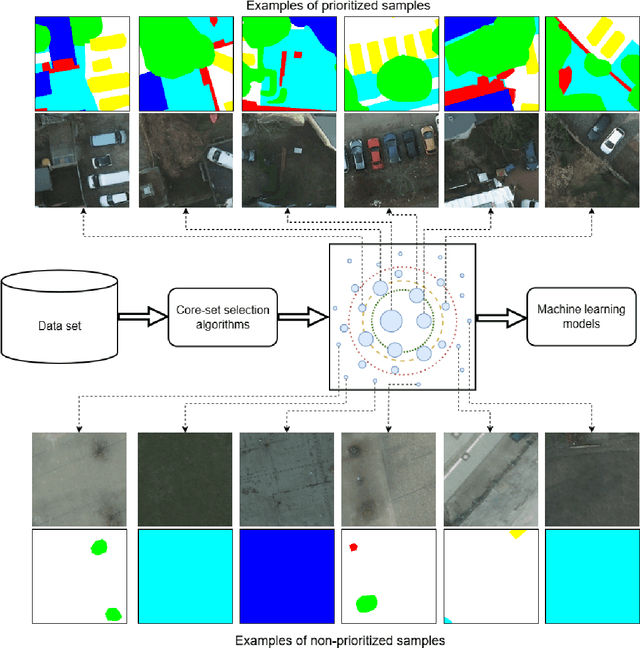
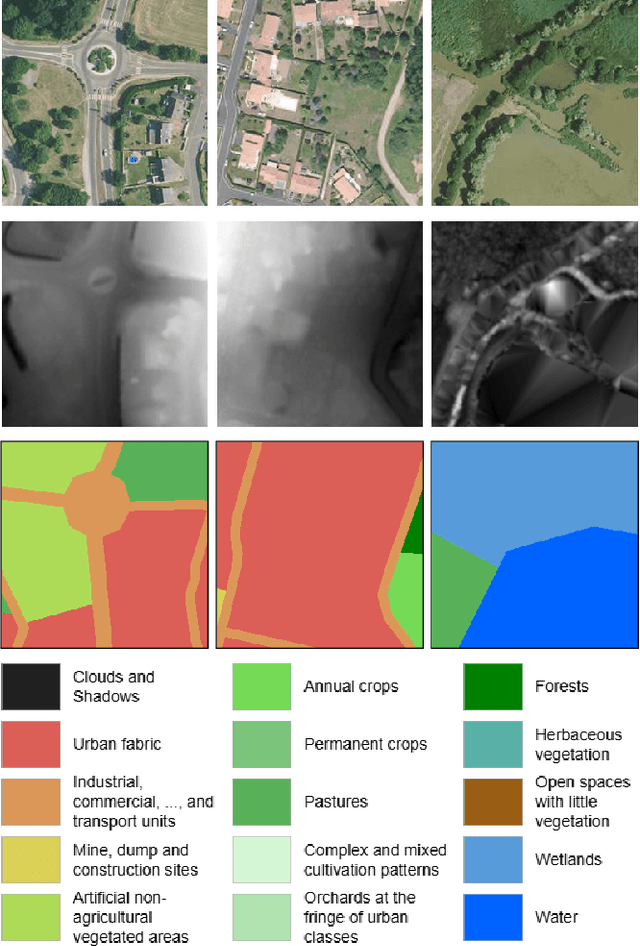
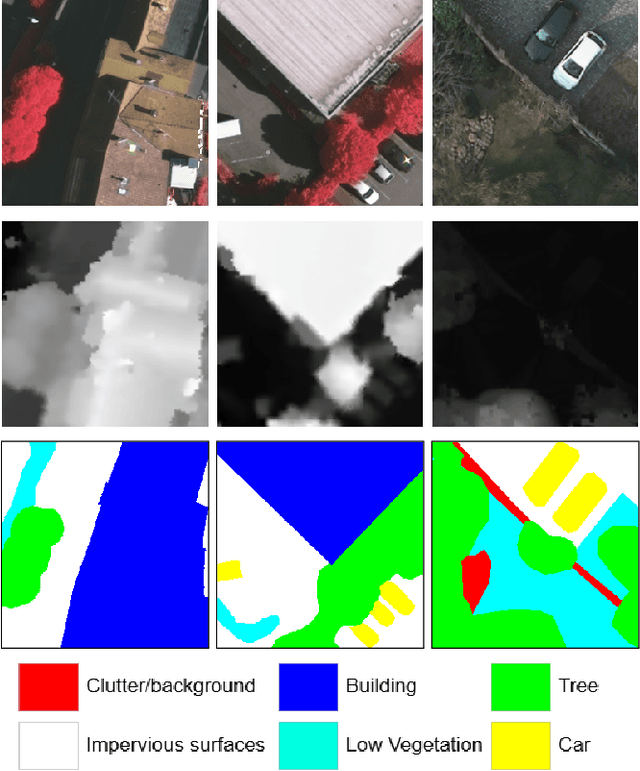
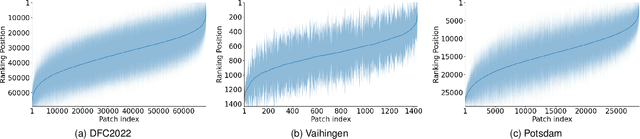
The increasing accessibility of remotely sensed data and the potential of such data to inform large-scale decision-making has driven the development of deep learning models for many Earth Observation tasks. Traditionally, such models must be trained on large datasets. However, the common assumption that broadly larger datasets lead to better outcomes tends to overlook the complexities of the data distribution, the potential for introducing biases and noise, and the computational resources required for processing and storing vast datasets. Therefore, effective solutions should consider both the quantity and quality of data. In this paper, we propose six novel core-set selection methods for selecting important subsets of samples from remote sensing image segmentation datasets that rely on imagery only, labels only, and a combination of each. We benchmark these approaches against a random-selection baseline on three commonly used land cover classification datasets: DFC2022, Vaihingen, and Potsdam. In each of the datasets, we demonstrate that training on a subset of samples outperforms the random baseline, and some approaches outperform training on all available data. This result shows the importance and potential of data-centric learning for the remote sensing domain. The code is available at https://github.com/keillernogueira/data-centric-rs-classification/.
Global Renewables Watch: A Temporal Dataset of Solar and Wind Energy Derived from Satellite Imagery
Mar 19, 2025We present a comprehensive global temporal dataset of commercial solar photovoltaic (PV) farms and onshore wind turbines, derived from high-resolution satellite imagery analyzed quarterly from the fourth quarter of 2017 to the second quarter of 2024. We create this dataset by training deep learning-based segmentation models to identify these renewable energy installations from satellite imagery, then deploy them on over 13 trillion pixels covering the world. For each detected feature, we estimate the construction date and the preceding land use type. This dataset offers crucial insights into progress toward sustainable development goals and serves as a valuable resource for policymakers, researchers, and stakeholders aiming to assess and promote effective strategies for renewable energy deployment. Our final spatial dataset includes 375,197 individual wind turbines and 86,410 solar PV installations. We aggregate our predictions to the country level -- estimating total power capacity based on construction date, solar PV area, and number of windmills -- and find an $r^2$ value of $0.96$ and $0.93$ for solar PV and onshore wind respectively compared to IRENA's most recent 2023 country-level capacity estimates.
FLAVARS: A Multimodal Foundational Language and Vision Alignment Model for Remote Sensing
Jan 14, 2025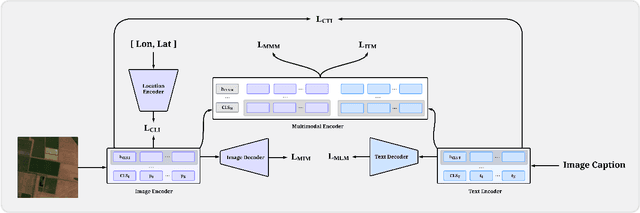
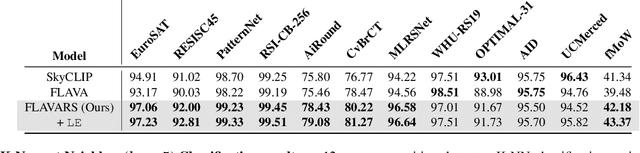
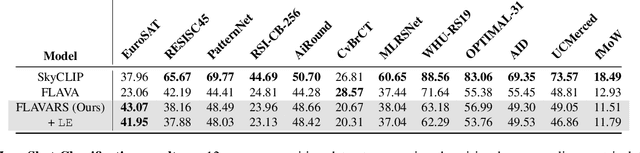
Remote sensing imagery is dense with objects and contextual visual information. There is a recent trend to combine paired satellite images and text captions for pretraining performant encoders for downstream tasks. However, while contrastive image-text methods like CLIP enable vision-language alignment and zero-shot classification ability, vision-only downstream performance tends to degrade compared to image-only pretraining, such as MAE. In this paper, we propose FLAVARS, a pretraining method that combines the best of both contrastive learning and masked modeling, along with geospatial alignment via contrastive location encoding. We find that FLAVARS significantly outperforms a baseline of SkyCLIP for vision-only tasks such as KNN classification and semantic segmentation, +6\% mIOU on SpaceNet1, while retaining the ability to perform zero-shot classification, unlike MAE pretrained methods.
Distribution Shifts at Scale: Out-of-distribution Detection in Earth Observation
Dec 18, 2024Training robust deep learning models is critical in Earth Observation, where globally deployed models often face distribution shifts that degrade performance, especially in low-data regions. Out-of-distribution (OOD) detection addresses this challenge by identifying inputs that differ from in-distribution (ID) data. However, existing methods either assume access to OOD data or compromise primary task performance, making them unsuitable for real-world deployment. We propose TARDIS, a post-hoc OOD detection method for scalable geospatial deployments. The core novelty lies in generating surrogate labels by integrating information from ID data and unknown distributions, enabling OOD detection at scale. Our method takes a pre-trained model, ID data, and WILD samples, disentangling the latter into surrogate ID and surrogate OOD labels based on internal activations, and fits a binary classifier as an OOD detector. We validate TARDIS on EuroSAT and xBD datasets, across 17 experimental setups covering covariate and semantic shifts, showing that it performs close to the theoretical upper bound in assigning surrogate ID and OOD samples in 13 cases. To demonstrate scalability, we deploy TARDIS on the Fields of the World dataset, offering actionable insights into pre-trained model behavior for large-scale deployments. The code is publicly available at https://github.com/microsoft/geospatial-ood-detection.
Sims: An Interactive Tool for Geospatial Matching and Clustering
Dec 13, 2024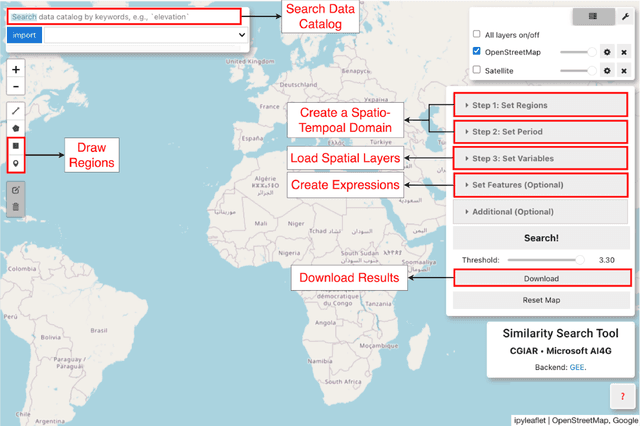
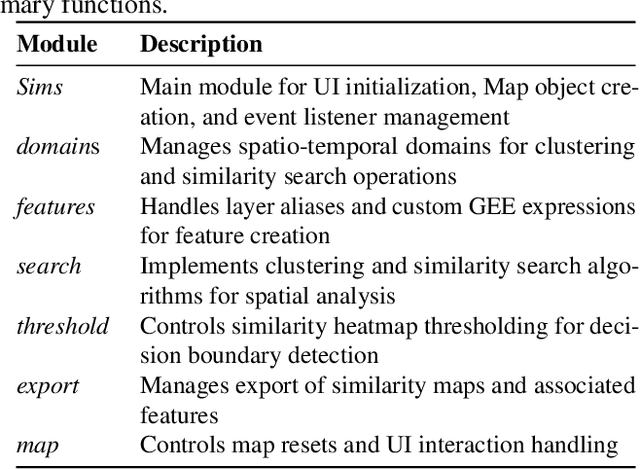
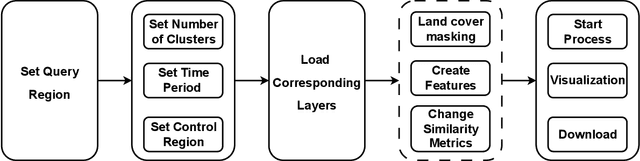
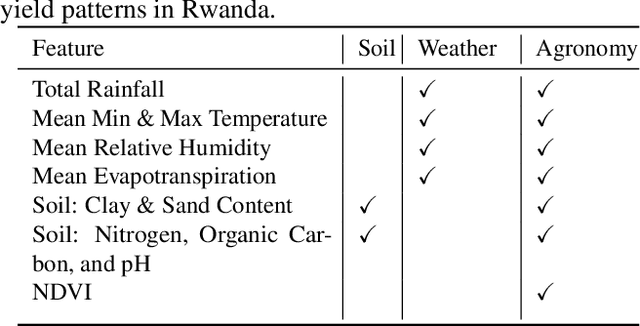
Acquiring, processing, and visualizing geospatial data requires significant computing resources, especially for large spatio-temporal domains. This challenge hinders the rapid discovery of predictive features, which is essential for advancing geospatial modeling. To address this, we developed Similarity Search (Sims), a no-code web tool that allows users to visualize, compare, cluster, and perform similarity search over defined regions of interest using Google Earth Engine as a backend. Sims is designed to complement existing modeling tools by focusing on feature exploration rather than model creation. We demonstrate the utility of Sims through a case study analyzing simulated maize yield data in Rwanda, where we evaluate how different combinations of soil, weather, and agronomic features affect the clustering of yield response zones. Sims is open source and available at https://github.com/microsoft/Sims